
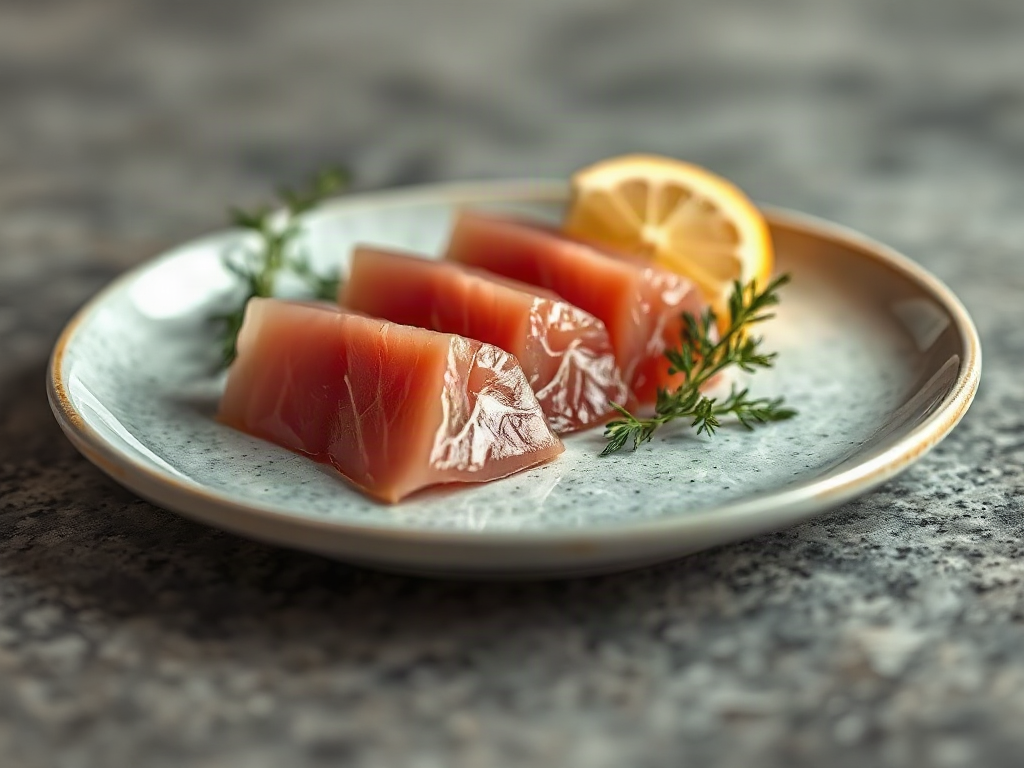
A practical sashimi tuna portion is about 3–4 ounces, providing roughly 20–30 grams of protein with little carbohydrate, but mercury exposure depends heavily on the tuna species and how often it is eaten. Larger predatory tuna, including bigeye and some bluefin, generally accumulate more mercury than smaller species such as skipjack. Portion control reduces exposure only when serving size and frequency are considered together. People who are pregnant, may become pregnant, are breastfeeding, or are feeding children should follow current FDA and EPA species-specific seafood advice.
What Nutrients Does Sashimi Tuna Provide?
Tuna sashimi is primarily a lean, protein-rich food rather than a complete meal. Plain slices contain high-quality protein with all essential amino acids, along with vitamin B12, selenium, niacin, and vitamin B6. Tuna also supplies omega-3 fats, although the amount differs by species, cut, season, and fat content. A pale, lean yellowfin cut and fatty bluefin belly should not be treated as nutritionally identical.
The absence of rice makes sashimi different from tuna sushi rolls or nigiri. Plain sashimi has negligible carbohydrate, while nigiri adds seasoned rice and a roll may include sauces, fried coatings, or mayonnaise. Those additions can substantially change carbohydrate, sodium, and energy intake even though the visible amount of tuna is modest. Soy sauce also adds sodium without changing the fish’s mercury content.
A typical 3-ounce serving of lean raw tuna often provides approximately 20–25 grams of protein. Exact values should be treated as estimates because restaurant slices are not standardized and nutrition databases distinguish among yellowfin, bluefin, skipjack, albacore, and other species. Fatty belly cuts generally contain more energy and fat than lean back cuts. They may taste richer, but a higher price or deeper color does not automatically mean more protein or lower mercury.
The most useful nutritional comparison is the whole plate. Six ounces of sashimi may supply ample protein but little fiber and limited carbohydrate. Pairing a moderate portion with edamame, seaweed salad with restrained dressing, vegetables, or a small serving of rice creates a more rounded meal. Conversely, relying on sashimi alone because it is “pure protein” can leave an active person short of energy or leave someone seeking fullness without enough fiber and food volume.
A common mistake is assigning health value based only on leanness. Dietary fat is not inherently undesirable, and fatty fish can contribute useful omega-3 fats. The relevant tradeoff is that tuna species associated with desirable flavor or fattiness may also be large, long-lived predators with greater potential to accumulate mercury. Nutrient density therefore does not cancel contaminant exposure, and mercury concern does not erase tuna’s protein value.
How Much Protein Is in a Serving?
Three to four ounces of tuna sashimi generally supplies enough protein to anchor a meal for many adults. Using an approximate range of 20–25 grams per 3 ounces, a 4-ounce order may provide roughly 27–33 grams. Restaurant portions vary, so slice count is a weak measuring tool: one chef may cut six thin pieces from the same weight another serves as four thick pieces.
Protein concentration stays fairly similar across many tuna species, while fat and mercury can differ more meaningfully. That makes “Which tuna has the most protein?” less useful than asking which species is being served, how large the portion is, and what else is on the plate. Doubling an order doubles protein, but it also increases mercury exposure from that meal. More protein is not automatically more appropriate once the meal already meets the eater’s needs.
| Serving or choice | Approximate protein | Practical interpretation |
|---|---|---|
| 3 ounces lean tuna | About 20–25 grams | A moderate protein anchor for a mixed meal |
| 4 ounces lean tuna | About 27–33 grams | A common meal-sized portion for many adults |
| 6 ounces lean tuna | About 40–50 grams | Higher protein, but also twice the fish exposure of 3 ounces |
| Tuna nigiri | Depends on fish weight | Rice adds carbohydrate; piece count does not reveal tuna ounces |
These ranges are planning estimates rather than labels for a specific restaurant order. A kitchen scale gives the clearest home measurement. At a restaurant, asking whether an order contains approximately 3, 4, or 6 ounces is more informative than estimating from appearance. If staff cannot identify the species or portion weight, uncertainty should be part of the decision rather than filled with an assumption.
Needs also vary. A smaller person eating sashimi with edamame may require less tuna than an athlete using it as the main protein after training. Older adults and people managing a medical condition may have individualized protein targets from a clinician or dietitian. Adding another low-mercury protein—such as tofu, egg, or beans—can enlarge a meal without making a large tuna order the only route to satiety.
The clearest sign that the portion works is not maximal protein; it is a meal that fits the person’s broader intake without requiring frequent oversized tuna servings. If fullness depends on 8 or 10 ounces of sashimi, adding vegetables, rice, avocado, or another protein may be a better adjustment than continually increasing tuna.
Which Tuna Has More Mercury?
Mercury levels tend to be higher in large, long-lived predatory tuna because methylmercury builds in an individual fish and becomes concentrated through the food chain. Species name matters, but fish size, age, harvest location, and the particular specimen create variation within a species. A menu label cannot reveal the laboratory result for an individual serving.
Bigeye and bluefin warrant more caution than smaller tuna in routine meal planning, while skipjack is generally associated with lower mercury. Yellowfin commonly occupies a middle ground, and albacore is generally higher than skipjack. These are broad tendencies, not promises about a particular slice. The marketing term “ahi” can refer to yellowfin or bigeye, which makes it inadequate for mercury decisions unless the restaurant identifies the species.
Mercury cannot be removed by searing, freezing, marinating, or trimming the fish. It is distributed through the tissue, so kitchen preparation does not solve the issue. Smaller portions reduce the amount consumed in one meal, but frequency remains equally relevant. A small order eaten repeatedly may create more cumulative exposure than a larger order eaten occasionally.
Pregnant people, those who may become pregnant, breastfeeding parents, and young children should use current FDA and EPA fish-advice charts rather than a generalized rule for adults. Those charts sort seafood choices by mercury considerations and provide age- or life-stage-specific serving guidance. Because restaurant names can be ambiguous, choosing a clearly identified lower-mercury fish is more actionable than trying to calculate exposure from “tuna sashimi.” A clinician can provide individualized advice when seafood intake is frequent or the species is uncertain.
Mercury concerns should not lead to the assumption that all seafood must be avoided. Seafood can supply protein and other nutrients, and lower-mercury choices allow variety. Salmon, shrimp, sardines, and some shellfish can diversify a sashimi or cooked seafood meal, though raw-food restrictions still apply separately. The practical goal is species rotation, not using the same large tuna as the default every time.
The most common failure is tracking ounces while ignoring identity. If the menu says only “tuna,” ask whether it is bigeye, yellowfin, bluefin, albacore, or another species. If no one can answer, anyone in a mercury-sensitive group has a sound reason to choose a clearly named alternative.
How to Choose a Portion and Eating Frequency
Portion and frequency should be planned together because each contributes to total exposure. A 3- to 4-ounce serving is a useful adult meal reference, but it is not a universal prescription. Body size, life stage, the species served, other seafood eaten that week, and individualized medical guidance can change the appropriate choice.
Start by identifying the tuna rather than ordering by color or price. Next, estimate the actual fish weight and review other recent seafood meals. Someone who had albacore at lunch and plans tuna sashimi at dinner is making a different exposure decision from someone who has not eaten tuna for several weeks. Rotating proteins makes portion control easier because it removes pressure to define one supposedly safe tuna number for every situation.
- Confirm the species. Treat “ahi” and “tuna” as incomplete descriptions.
- Choose the fish weight. Use roughly 3–4 ounces as a meal reference rather than relying on slice count.
- Check recent intake. Include canned tuna, tuna steaks, poke, and sushi—not only sashimi.
- Account for life stage. Apply current government advice for pregnancy, breastfeeding, and children.
- Rotate the next meal. Select a lower-mercury seafood or a non-fish protein instead of repeating large predatory tuna.
A restaurant scenario shows why this sequence matters. An eight-piece bluefin tasting may contain a different fish weight than an eight-piece yellowfin order, while a mixed platter spreads the meal across several species. Ordering four ounces of known yellowfin with salmon and vegetables gives more decision information than ordering an unspecified “tuna deluxe” and assuming premium fish is safer.
There is no reliable visual signal that mercury planning is working; methylmercury has no taste or odor. Success therefore comes from a repeatable record of species, portions, and variety. The approach is failing when tuna appears in several formats across the week without being counted together, restaurant terminology is accepted without clarification, or smaller servings are used to justify very frequent consumption.
People who eat tuna often may find a simple food log useful. It need not calculate mercury precisely. Recording “3 ounces yellowfin sashimi” or “albacore sandwich” is enough to reveal repetition. When species remain unknown, conservative substitution is more dependable than invented precision. Government seafood charts and a registered dietitian can help translate the pattern into individualized choices.
Raw Tuna Safety Beyond Mercury
Raw-fish safety is a separate decision from mercury exposure. A low-mercury species is not automatically safe to eat raw, and high-quality handling does not lower mercury. Sashimi can carry hazards associated with pathogens, parasites, temperature abuse, and cross-contamination, so purchasing decisions need to address both contaminant exposure and raw-food handling.
“Sushi-grade” or “sashimi-grade” may communicate a seller’s intended use, but consumers should not treat the phrase alone as a complete safety guarantee. Buy from a supplier experienced in fish intended for raw consumption, verify that the tuna has remained properly refrigerated, and follow seller instructions for storage and use. At home, keep raw tuna cold, prevent its juices or utensils from contacting ready-to-eat foods, and discard fish with concerning odor, texture, packaging, or temperature history.
Freezing requirements and parasite controls depend on species and commercial handling, and freezing does not correct every problem. It does not remove mercury, reverse spoilage, or reliably eliminate all microorganisms. Briefly searing the outside leaves the center raw, so it should not be treated as equivalent to thoroughly cooking the fish. Marinades containing citrus, vinegar, soy sauce, or wasabi also do not make mishandled fish safe.
People who are pregnant, older, immunocompromised, or managing certain chronic conditions may be advised to avoid raw or undercooked seafood because foodborne illness can carry greater consequences. Current public-health guidance and advice from a qualified clinician should take priority over restaurant assurances. Cooked lower-mercury seafood can preserve the meal’s protein contribution while reducing the distinct risks associated with raw fish.
A practical home check is to separate three questions: Is the species suitable for the eater’s mercury limits? Was this fish specifically supplied and handled for raw consumption? Is the eater in a group advised to avoid raw seafood? A favorable answer to one does not substitute for the others. The common mistake is using freshness as a universal safety test; fish can look appealing without answering species, contaminant, or microbial questions.
Conclusion
Tuna sashimi can be a compact source of high-quality protein, vitamin B12, selenium, and other nutrients, but species identification deserves as much attention as serving size. Use roughly 3–4 ounces as a practical adult meal reference, then adjust for personal needs, accompanying foods, recent tuna intake, and current life-stage guidance. Ask whether “ahi” means yellowfin or bigeye, count canned tuna and poke in the same intake pattern, and rotate with lower-mercury seafood or non-fish proteins.
Mercury cannot be cooked or frozen away, while raw-fish handling introduces a different category of risk. Choose experienced suppliers, maintain cold storage, avoid relying on appearance or “sushi-grade” wording alone, and use cooked seafood when raw fish is inappropriate. Anyone who is pregnant, breastfeeding, feeding a child, immunocompromised, or eating tuna frequently should compare their pattern with current government guidance and seek individualized professional advice when needed.
Frequently Asked Questions
How much protein is in four ounces of tuna sashimi?
Four ounces of lean tuna commonly provides about 27–33 grams of protein. The exact amount varies with species, cut, and measured weight, so restaurant slice count is not a precise substitute for ounces.
Is tuna sashimi high in mercury?
It can be, especially when the fish is bigeye, bluefin, or another large predatory tuna. Skipjack is generally lower, while yellowfin and albacore require species-aware portion and frequency decisions.
Does freezing sashimi tuna remove mercury?
No. Mercury is present in the fish tissue and is not removed by freezing, cooking, searing, or marinating. Freezing may be part of parasite-control procedures, but that is a separate issue.
Can pregnant people eat tuna sashimi?
Raw seafood is generally a separate pregnancy safety concern from mercury. Pregnant people should follow current FDA and EPA seafood advice and ask their healthcare professional about cooked species and portions appropriate for them.
Is sashimi healthier than tuna rolls?
Sashimi usually contains less carbohydrate and fewer sauce-related ingredients, but “healthier” depends on the meal. It does not avoid mercury or raw-fish hazards, and a balanced plate may still need vegetables, fiber, or an energy source.